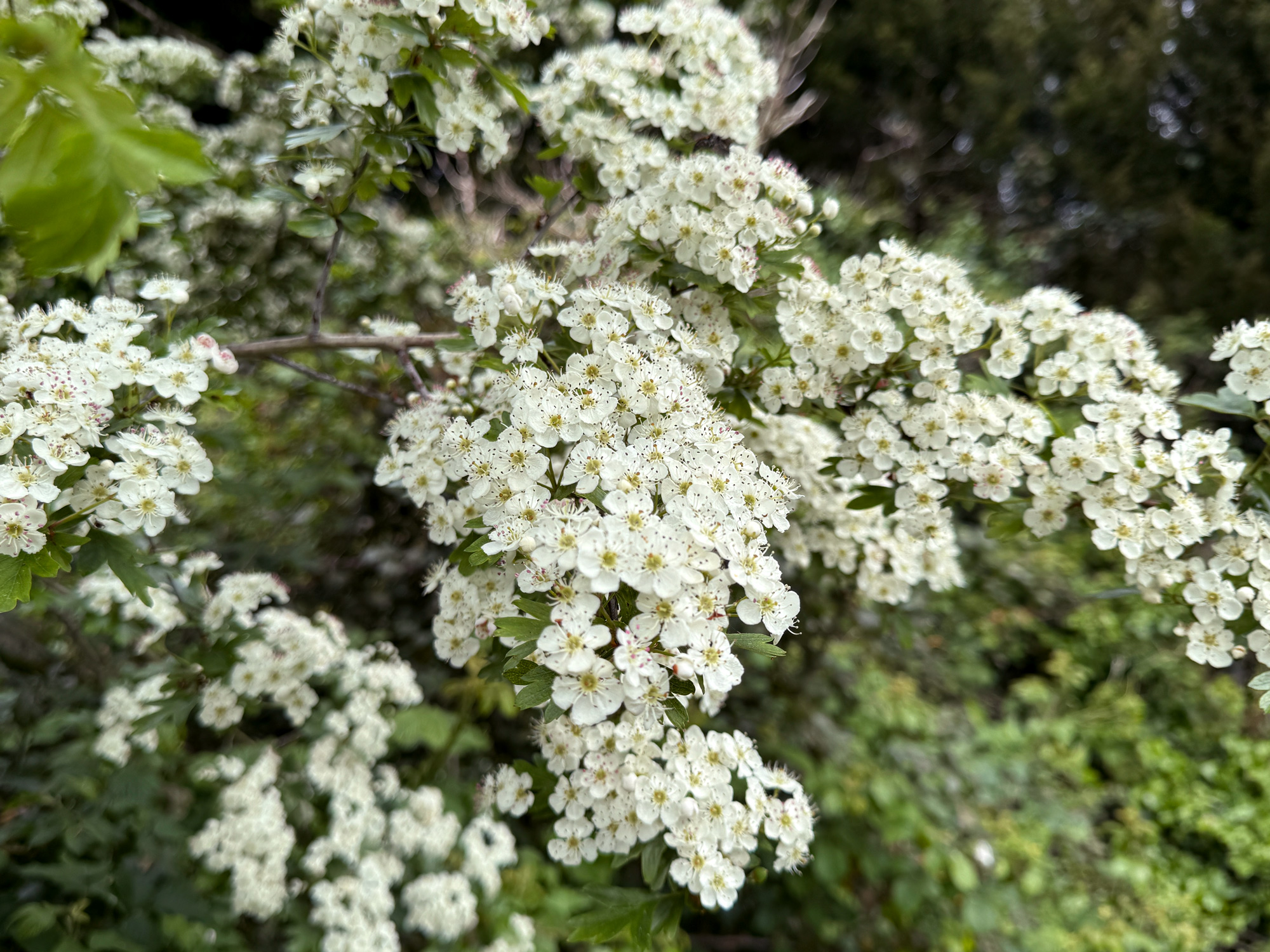
There is a moment in May when the hedges in Wales become almost too full of blossom. You walk past them and the white flowers seem to be arriving faster than the eye can count them. Hawthorn is not a delicate, polite flower. It is generous. It comes in clouds.
For most of the year a hawthorn hedge is easy to ignore. It is just there: a scratchy green wall between road and field, pretending not to be interesting. Then May arrives and suddenly the same hedge is showing off like it has been waiting all year for applause.
The white is not white
The funny thing about white flowers is that they are almost never white. They are grey, cream, greenish, bluish, warm in the shadow, cold in the wind. White is mostly the rumour they spread about themselves.
Flowering hawthorn is especially good at this trick. Against dark leaves it looks bright. Against a pale sky it almost disappears. On a grey Welsh morning it can look chalky and cool; in the evening it turns softer, almost creamy.
That is the part I like when drawing from nature. The plant says “white blossom” and then hands you twenty other colours to deal with.
The useful mess
Spring in Wales is not tidy. It is windy, wet, green, and slightly overexcited. Flowers turn up beside roads, around parks, near old walls, in gardens, and along paths where nobody has arranged them for a picture.
I like that kind of beauty. It does not ask permission. It just appears and gets on with things.
Hawthorn belongs to hedgerows, lanes, field edges and footpaths. It is not a flower that waits politely in a vase. It scratches, tangles, feeds insects, shelters birds, and then, for a few weeks, covers itself in blossom as if this was all perfectly normal.
May blossom and memory
In Britain, hawthorn is often called May blossom. I like that name. It is not trying to sound botanical. It simply says: look now.
And you do have to look now. By the time you decide the hedge is at its best, it is already changing. The flowers brown at the edges. The leaves thicken. The white cloud becomes a green hedge again. Nature is very good at moving on before we have finished admiring it.
Looking closely
If I were drawing flowering hawthorn, I would not try to draw every flower. That way madness lies, and also a very stiff drawing. I would start with the dark branches and the heavier greens, then add the blossom as a rhythm: some sharp marks, some lost ones, some almost accidental.
What I like about hawthorn is that it refuses to be only pretty. The flowers arrive in soft white heaps, almost bridal if you squint, and then the plant immediately reminds you that it has thorns and no interest in behaving nicely.
That makes it much more interesting than a tidy spring postcard. A flowering hawthorn hedge is sweetness with scratches, May blossom with a bit of attitude, and a very useful reminder that nature rarely bothers to be tasteful for our convenience.